


Back on track for success in no time: integrated planning meets cost efficiency
01
The client
Today, when companies initiate optimization projects, expectations often center on delivering fast, measurable impact. For many manufacturers, this requires not only operational improvements but also a fundamental rethink of planning and organizational models.
Our client, a medium-sized manufacturer of electrical equipment with three business units and global presence, set exactly such expectations. Recognized as an innovation leader in its field, the company combines advanced technologies with decades of industry expertise.
02
Challenges
Despite innovation leadership and strong market position, the client faced rising costs compared to competitors and struggled with low productivity. Planning was largely reactive and lacked consistency. Operative processes were characterized by chaotic workflows, while a siloed organization and the absence of a performance-driven culture made it difficult to achieve alignment and efficiency.
03
Service provided
To address the client’s challenges in a sustainable way, it was essential to move beyond isolated improvement initiatives. The root causes were in the interaction between planning, processes, organizational structure, and management behaviour.
We therefore designed a two-phase transformation program. The first phase focused on creating full transparency on the current state, identifying fact-based improvement potential, and translating these insights into a clear, prioritized improvement roadmap. The second phase focused on execution. Together with the client, multiple workstreams were launched to translate the roadmap into action, combining quick wins with structural improvements in planning, execution, and organizational design.
04
Phase 1: Assessment
We started with a two-week wall-to-wall assessment, spanning the shop floor, administrative functions, and management. Through direct observations, supervisory studies, and detailed data analyses, we built a comprehensive picture of the company’s current state. This laid the foundation for evaluating productivity and efficiency levels, identifying tangible improvement potential, and provided bulletproof evidence for feedback discussions with management.
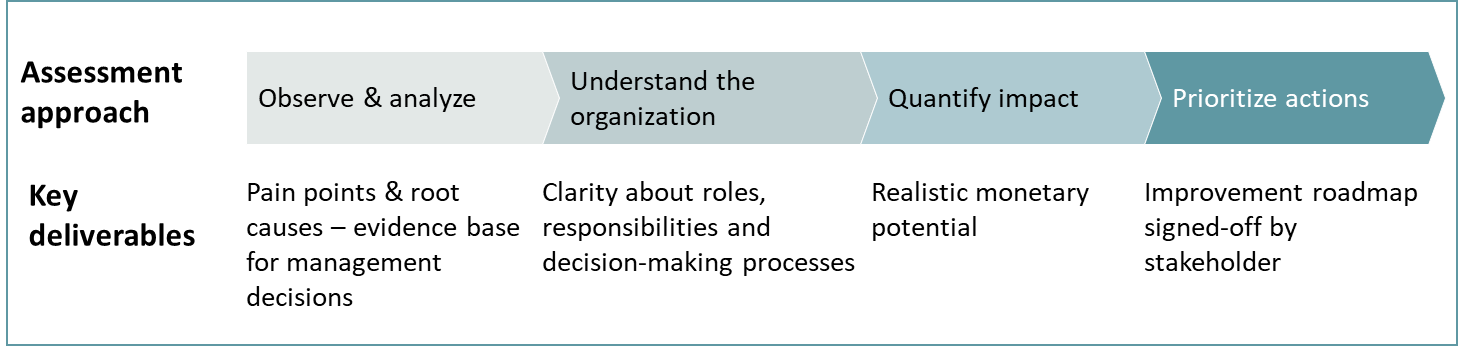
Figure 1: Key deliverables
05
Phase 2: Improvement
After clarifying the current status and optimisation potential for each department, it was time to take action.
Quick Wins
Together with the client, we implemented quick wins to achieve initial visible successes and increase motivation for further change. We encouraged employees to rethink their processes and initiate improvements themselves, so that change was actively embraced at all levels.
The results: an organisation that celebrated early successes, actively learned and drove change independently.
Management System
We introduced a management system for timely performance measurement and capacity steering. This proved to be a quick win: within a short time, management gained a practical tool and a clear process to set targets, regularly assess adherence, define improvement measures, and track execution.
The results: higher productivity, stronger performance culture.
Sales & Operations Planning (S&OP)
Next, we addressed planning and processes. We supported the transition from chaotic and reactive planning, which varied across departments, to an integrated planning framework designed to reduce friction between management activities. On top of this, we implemented S&OP to close the gap between strategic planning and day-to-day operations, enabling the organization to act according to a single consensus plan.
The results: higher planning accuracy, improved productivity, shorter order lead times.
Redesign of processes and organization
Alongside our other workstreams, we partnered with the management team to break down organisational silos and eliminate process-inhibiting interfaces. Based on the client’s unique selling proposition (USP) and customer expectations at various touchpoints along the customer journey, we realigned all customer-facing processes. These changes to workflows and responsibilities challenged the traditional functional organizational structure. Through coordinated change management and clear communication, we supported the organizational transition toward a seamless, process-driven, and customer-centric model.
The results: efficient workflows, shorter lead times, quicker decisions
06
Benefits
The transformation delivered measurable and sustainable results within just 12 months:
- Productivity increased by 16 percent.
- Order lead times were reduced by 35 percent
- 18 percent improvement in on-time-in-full (OTIF) performance.
- The project generated more than five times return on investment (ROI) within the first year.
- Most importantly, a performance culture was established, ensuring that improvements continue to create impact well beyond the project timeline.
07
Our services
Find out more about Operational Excellence, Planning and Supply Chain Excellence.